

I began to learn the English language when I was 4 years old. I attended English school for 9 years, up until the year I left Brazil for the United States. Years later, this same language school has approached me for a number of interviews – testimonies – where I’d be sharing my “success story” as a student in America. It’d involve me talking to, like, a class of children, about how important this education had been to me.
It comes up while eating with my parents some evenings, how I haven’t responded to their requests. They’re disappointed in my unwillingness, ungratefulness, even. My account would be a kind of ‘thank you’ for preparing me for my time abroad, for giving me the privilege of understanding (in a vague and allegorical sense, and always from a certain perspective) what American culture meant. Over the years, I’d share what I was taught with the people around me, even my friends – that the internet was in English, so not speaking it is just missing out. It felt as if this language was the most important skill one could have, one that launched careers, made us more worldly and developed, more knowledgeable about all aspects of life. It was a way to improve one’s status, or as the Portuguese goes, “mudar de vida”. Adults around me reinforced this belief, of course. Transfixed by the way foreign sound formed in my throat, they’d ask me to sound it out. Count from one to ten, or a third of the alphabet. The schwa, the dental fricative, the glottal stop. They were so transfixed it often felt they were looking through me. Peering into the English right behind my eyes.
My old school, the one who taught me all those things, doesn’t really exist anymore. A few years back it was acquired by a larger conglomerate of language schools, funded by American capital. And so its name and staff were changed completely.
When I’m home, I pass it by in the car with my mother. We still call it by the old name. I try to remember what it looked like all that time ago – some colors, the lettering on the cheap sign. I see the shape of the building, added to over time, but never really changed. Each window still in its place. I feel an absence, clawing its way back through its pale replacement. A phantom underneath.
I.
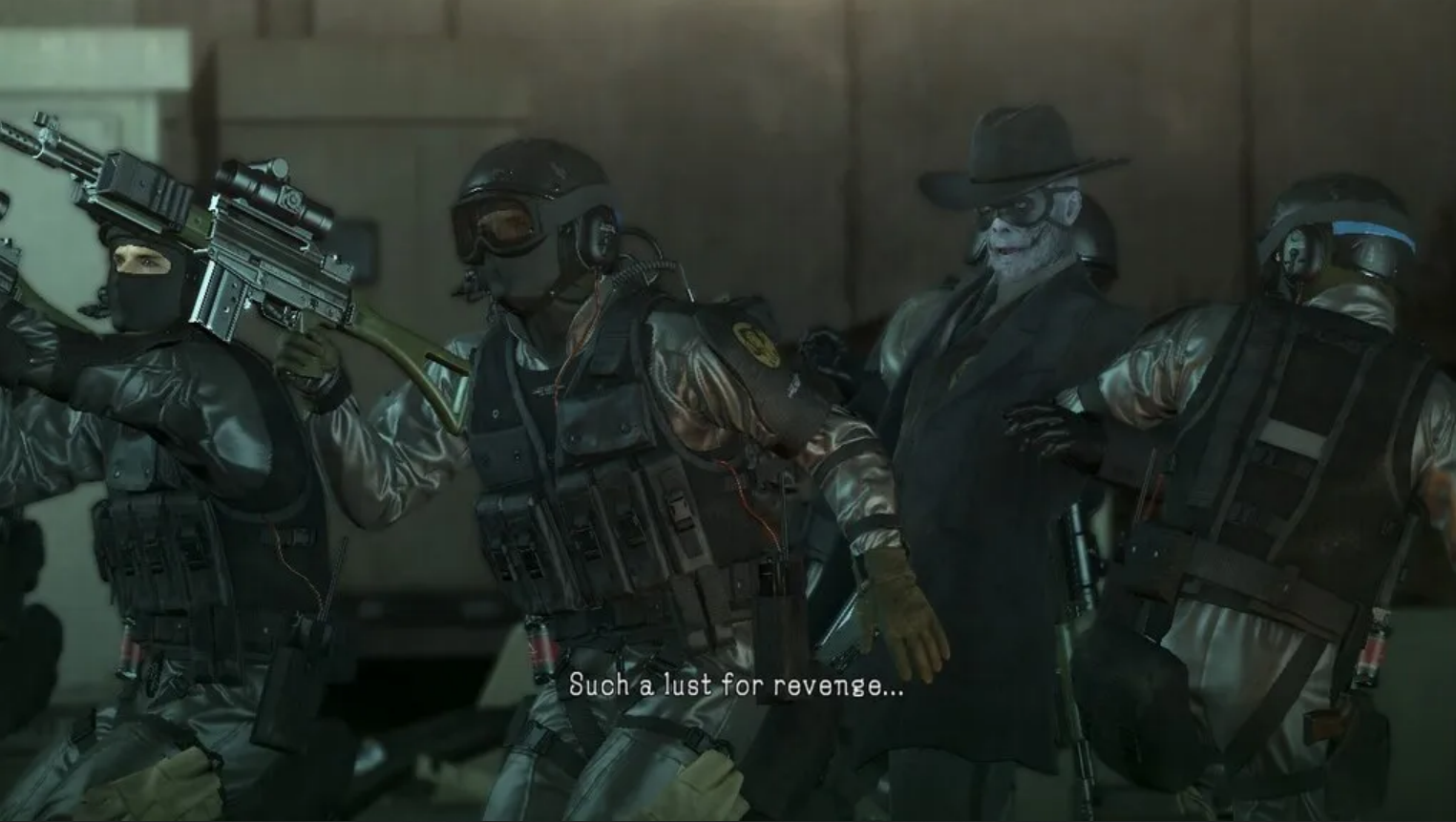
Here’s what playing Metal Gear Solid V: The Phantom Pain feels like:
Reaching out from a shadowed alley, I disappear a guard from his patrol route. From a distance, it appears that this leisurely stroller is touched by a darkness that simply, quickly drinks him up. Someone’s noticed – static appears on the screen, gestures to the witness.
“CP! This is Zoya 6, I’ve spotted something suspicious. Moving to investigate, over!”
I drag the guard back along the sand, further into shadow, holding a knife to his throat as his comrades search for him. We silently watch as they approach the site of the vanishing, mere feet away. I move his body like a doll’s, arm hooked and pulled beneath the armpit, compressing the carotid artery. I count from one to ten. “Nah, there’s nothing here”. He goes limp. I toss his unconscious body into a nearby dumpster.
There’s something thrilling about embodying a ghost. Our lives can often feel dictated by forces several levels above us, invisible hands guiding our fate. Stealth games allow us to act out this relationship from a different perspective; to easily remove pieces from play. Where other worlds exist to be killed, Metal Gear’s insistence on non-lethal approaches allows instead for preservation, for contingency: to keep pieces in play, and through this complication, create deeper involvement.
I skulk behind a wall, from underneath a truck, an open window. Each state in the CQC system flows into another, from the grab to the throw to the interrogation. You can point a rifle to a guard’s back only to notice their raised arms slowly lower, reaching towards a concealed sidearm – a denial of the stealth takedown, sacred object of an entire genre. Trip an enemy over and they’re down for brief seconds; slam them headfirst into a wall and they’re gone for around six minutes. The seconds are always counting down, and Metal Gear Solid V demands: look, listen, pay attention. Someone wakes up, betrays you, even outsmarts you. As the game progresses, you become more familiar with its apportioning of time, how it slices it up into shapes you can play with. One comes to understand how to move in the world always at its behest – looking for time, running from time, buying those few extra seconds to get 3 guys with a perfectly-thrown sleep grenade.
There are times this calculus doesn’t neatly resolve. Guards are constantly arriving and departing from Afghanistan’s bases and Angola-Zaire’s abandoned villages – and so are you. A patrol goes forgotten, a body you’d thought well-hidden is discovered. After guards go on alert, they remain so for three entire days, and if you thought you could quick-load, bad news – 15 or 30 minutes before disaster is the best you’ll do. To some, it might come across as too punishing. I, however, will always favor the game that makes me feel like I’m actually getting away with something.
As I spent time with the Phantom Pain, my personal style coalesced: gadget and item focused, consisting of cooking up Looney Tunes-ass scenarios with explosive conclusions. From clear blue skies, sandstorms can suddenly sweep in and blanket the world in a thunderous darkness, muffling, shrouding, turning the game on its head. Out of these perilous alignments, you feel something you wouldn’t really expect from a game like this one: you feel trust. It gives you so little until it gives you the world, and by then you know it’s fickle enough to take that chance. It opens and closes in the most naturalistic ways, and holds out a hand in the moments you need it to. There are no shortage of unfair-seeming tricks (my favorite is the smoking car) that taught me not to take things with this game so seriously. Given the choice, it chose opacity over transparency, and I think that’s great. You’ll just have to learn some things. Your reward, though: braving the sandstorm, you sprint up to a dude and sucker-punch him into the dirt, and the world around you roils so furiously that no one will bother to check if he still even exists.
Stealth games are explorations of control. The best stealth games are those which reflect on the way everyday life can suddenly snag. One can spend days patiently scouting, mapping approaches to complex situations, looking ahead for hidden problems. And then you take a wrong step, you run out of time. But in those moments, in the vacuum left by ruined plans, you find a hope: Creativity. You shoot the cameras out, quickly dive under an armored truck, an ally covering the retreat with a big-ass sniper rifle.

II.
Aabe Shifap Ruins, Northern Kabul, Afghanistan. A sinuous mountain path widens into a great clearing. The sun shines hard on the vast remains of forgotten ruins. The sudden opening makes the world before me seem so much smaller. Where am I? How did I get here? Faded geometric mosaics suggest what were once resplendent mosques. Roman architectural remains infiltrate, overlooked and undetected. Over the course of the game, various enemies briefly populate this place, before being captured or annihilated. It attracts no permanent residents. Despite its faded reliefs and collapsed balustrades, Aabe Shifap’s history remains untold.
In his commentaries in “Metal Gear Solid V: the Phantom Pain: The Complete Official Guide”, series director and auteur Hideo Kojima states: “You will have noticed that many of the locations in MGSV are in ruin. These are designed in this way to create new gameplay opportunities, enabling the player to approach facilities from different […] angles and heights.”
While the levels of Afghanistan – its arrangements of buildings, boxes, guard posts – are textured and varied, the actual world of Afghanistan is sterile by comparison. All the people that should occupy these locations seem to be long gone. Absolutely no traces are left of their struggle, not even corpses, except for one. The only Middle Eastern character we meet in the entire game, a nameless Hamid fighter in Afghanistan, is physically incapable of speaking. He is an optional objective in one of the game’s earlier missions, to retrieve a top-secret missile launcher under the orders of the CIA. The rest of his mujahideen, we later learn, were completely wiped out by Skull Face’s forces. We later explore their fortress, a majestic structure carved into the side of a mountain, a place they once existed in. We grab the rocket launcher, named Honey Bee, and leave.
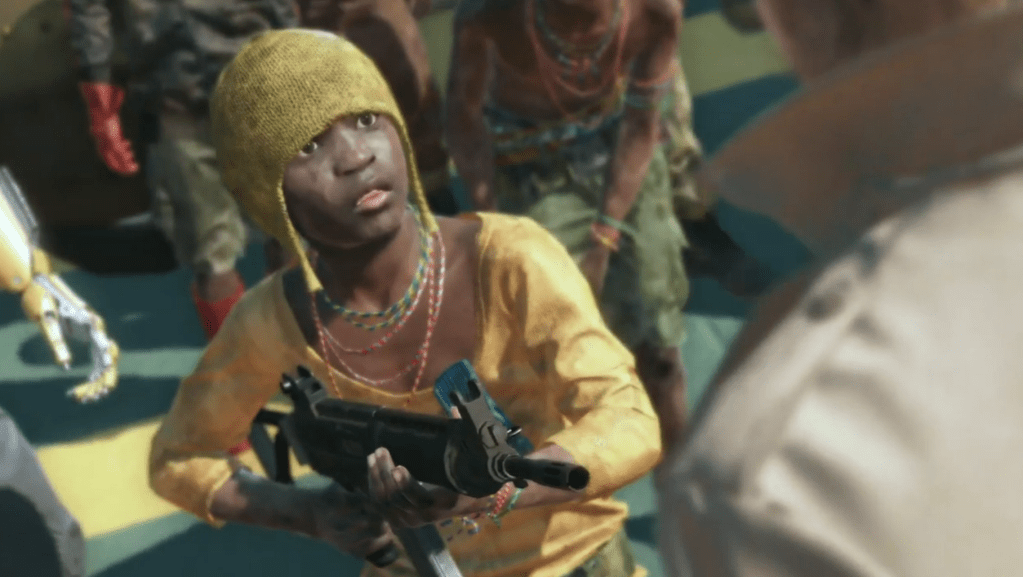
Angola-Zaire, in contrast, is filled with the bodies of its inhabitants. Many of them dead and discarded. All having suffered or constantly suffering. The local population is experimented on to develop Skull Face’s “weapon to surpass Metal Gear”, a lethal parasite that latches onto the vocal cords, activated by sound vibrations of the English language. Those who die are thrown into the reservoir of an oil-processing plant. The others are absent or burned. Only the children remain alive, recruited into the ranks of PMCs as child soldiers. Africa is the place that most reveals Metal Gear’s morbid fascination with suffering. People are broken and destroyed in so many ways it becomes hard to keep track. But that is precisely why you’ve come to Africa. To witness an other massacred.
Reid McCarter explores Spec Ops: The Line in a great essay for Bullet Points Magazine:
The Line’s UAE is […] a venom-dripping jungle, free of defined human influence, where a group of Western outsiders are given space and danger enough to have their character tested and trauma birthed. It’s a forge free of context, a nearly antediluvian space of floating battles between the cosmic protagonist and their shapeless devils.
Like in Spec Ops: The Line, beauty in Metal Gear flourishes most in the ashes of civilization, and is destroyed by the human touch. Little remains of culture in these brutalized landscapes. Hidden in a nondescript outpost in Kabul there is a tape of an “Afghan Lullaby” that, like an exotic spell, lulls all surrounding enemies into sleep. Overwhelmingly though, what survives are Top 40 anglophone hits that play from the radios of foreign soldiers. Africa and Afghanistan’s inhabitants survive only through phantoms. The player always maintains a “safe” level of remove, like an American mercenary occupying a foreign country.
Child soldiers, disappeared Afghans, dead Congolese floating in pools of crude oil – all of their wants and needs are unimportant to the story’s ultimate goal: to further a certain aesthetic vision. Their role as unwitting victims doesn’t make their absence feel any more poetic. They are used for their Arabness, Africaness, their suffering leveraged to create the dark, sinister tone that gamers everywhere have lauded Metal Gear for finally daring to explore. Everything else is erased.
III.
Metal Gear Solid is a contradictory series. Every character a triple agent, every entity a proxy for another. It’s intensely political, yet only its worst villains openly embrace ideology. But even it has its constants, patterns it consciously repeats: recurring storylines, cloning, parasitic transmission. And at its heart, the burning question: what do we choose to pass on onto the future? Who must be responsible?
So it’s saying a lot that the Phantom Pain just has a… weird vibe. No one really knows why anything is happening. Very little of your time is spent watching things actually unfold; most of the time, you follow, chase, deal with the actions of another. It is a game about being perpetually too late. Often, you don’t even get to do the shooting, and by the time you arrive, all that’s left are bodies. A lot of it is being distracted. A lot of it is, like hypnosis, being lulled into doing things you’re not quite sure why you’re doing. And not being able to stop.
There is a game-within-a-game in MGSV, much different than the rest of the experience. It’s Mother Base management. Like a dystopian Facebook farm game, players can assign recruits to missions they carry out in real-life time, sometimes 2 hours, sometimes 16, sometimes 3 days. Players then use the resources gained to develop stronger weapons and grow their R&D departments, and repeat the cycle again. There is a concerning amount of time to be spent here, from a top-down view, removed from the actions being carried out on your orders. It should be no surprise some of them are suspicious, like “Restore the DMZ” or “Eliminate the Dictator”. And then I unlocked a pistol that could pierce bulletproof helmets. And the game began to eat itself.
It destroyed adaptive difficulty, the game system that changes guards’ behavior and equipment to better adapt to your aggressions. All of a sudden, their helmets didn’t matter anymore. I’d completely eclipsed game design with the sheer power of capital. With the more and more lethal weapons I’d unlocked, the more their forbidden power gained an allure. It was not through exploring the game’s world or speaking to its characters that inspired that feeling. It was through growing engagement with its most capitalistic, data-driven elements. The more GDP I amassed, the more disposable my under-performing employees became. I scoured the map for A+ soldiers, and disposed of the rest. Soon I came for them too, replaced by the A++ recruits. And then came the S-ranks, S+, and so on.
Every single Metal Gear game before this one has a section where you survive torture. It’s no accident that in the Phantom Pain, the player is the one that presides over these scenes – Quiet, Huey, and other members of Diamond Dogs are subjected to what Snake once was. A player is left thinking: why? Why turn this violence inwards, even if it could be worth it (it never is)? Venom Snake seems infected by an obsession with efficiency. All of a sudden, the ends justify every mean. A great obsidian horn grows out of his head like a devil. It is so tempting to access the forbidden, but once you have, it holds onto you like a curse. You reek of it. You allow it to take over every choice, each kill whittling down contingency, squeezing the game’s intricate systems until…
One looks back on an outpost of murdered guards and feels a kind of emptiness. Only stillness where there once was motion. The game’s final hours are animated by this grotesque idea. It is an obsession that destroys it.
IV.
Endlessness is The Phantom Pain’s ultimate cruelty. Revenge is achieved, the credits roll, and… You’re back in your base. You go on missions against other players now, where you can amass even more wealth, and also build nukes. Most of it feels like an eternal shift in a PMC’s HR department, policing those good reliable numbers and their roots, movements, ends. Complete nuclear disarmament was something players could build towards by stealing and decommissioning others’ nukes, but it couldn’t even be achieved without cheating. And then players just developed more nukes right after.
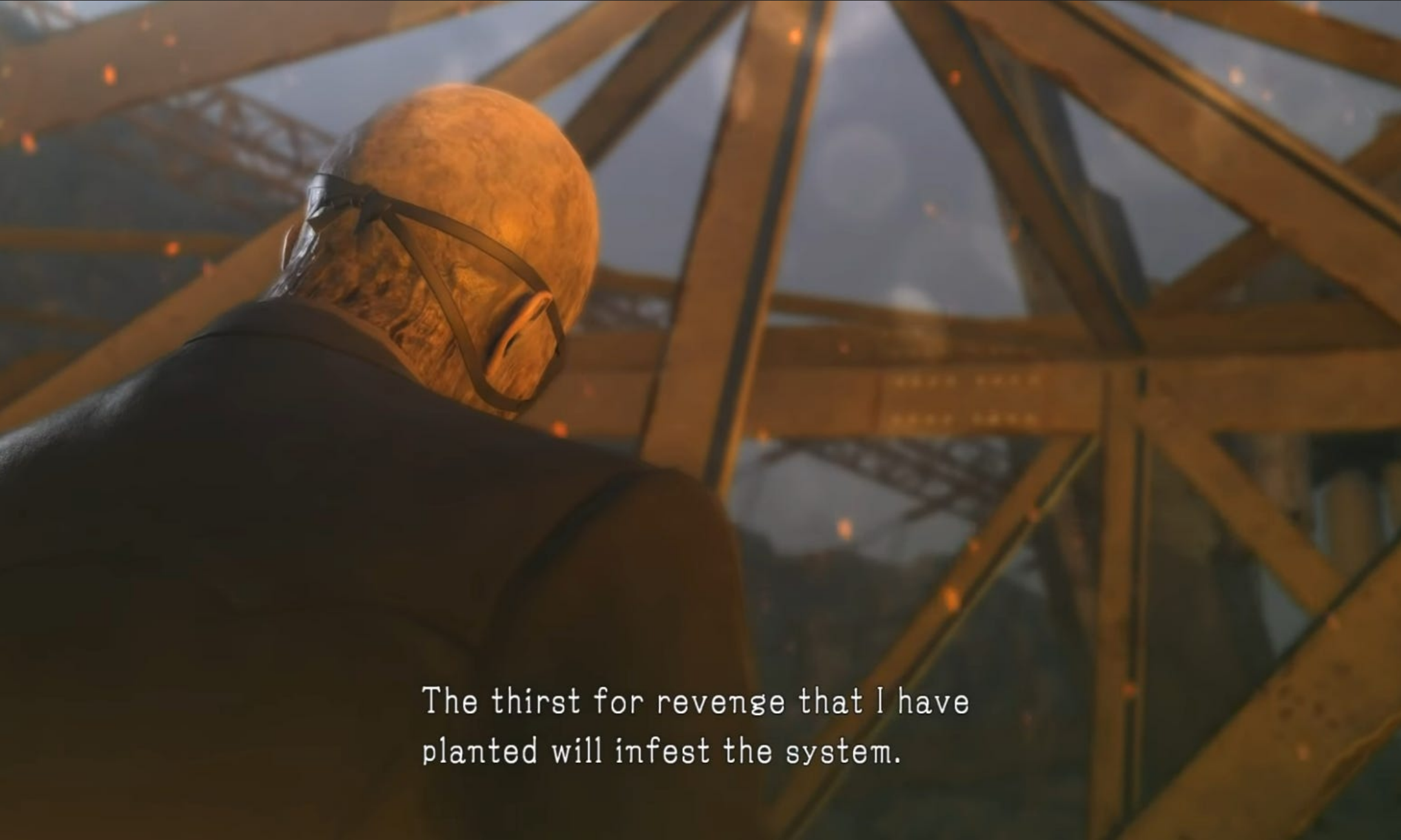
Skull Face ended up as the latest in a long line of individuals used, brutalized, and discarded by empire. Born in Hungary, he rose from the Allied bombings as a self erased of all but hatred, split between the Soviet Union, England, and the United States. He never again spoke his mother tongue. In his final appearance, Venom mutilates his body and limbs, fulfilling the revenge for the old Mother Base and MSF. Skull Face’s burden is also a revelation with franchise-wide implications: for 20 years since Metal Gear Solid 3, he’d followed you around the world, cleaning up the messes Snake couldn’t be bothered to. Every corpse left behind, alert triggered, building blown to pieces. Skull Face’s curse was to be a man of the future who changed how we look at the past. In the end, it broke him.
America emerged out of World War II as the ones who fought the Nazis and won. But it’s impossible to not contend with the wreckage the “good guys” left in their wake – broken people, driven by vengeful and violent spirits, the living turned phantoms. Oh, and atomic warfare. Pain, Metal Gear Solid V says, is the secret driver of history. It will exist as long as “heroes” exist, because no act is without consequence. Those cheated, wronged, beaten by the heroes; they too pass ideas onto the future. The game asks: who will stop the hero who gets dirty so the world can stay clean?
Not you, it answers. With revenge, Venom Snake closes a cycle that begins anew, writes a new legacy of murder into history, one that will one day create the series’ ultimate villain. After that final fade to black, his (and your) role is clear: to be a powerless piece in it all, a lonely combatant in a proxy war without end. But who could be more responsible, more accountable, than the one who pulled the trigger?
Who else but the player?
I don’t know if the second-to-last Metal Gear game (yeah, I’m counting Survive) was intended to be as mysterious as it is. Was that mystery born from deliberate decisions, budget constraints or, more simply, a failure to execute a story with two decades of narrative baggage? I certainly won’t claim it was a cry from an auteur’s mind tormented by franchise fatigue, because that’s a coward’s opinion. There’s tremendous sincerity behind Metal Gear Solid V. Prior to release, it was thought of as the final piece in the puzzle, the game that would solve Metal Gear’s tangled named protagonists and muddled organizations. It didn’t seem to have panned out that way, but to me it felt like the culmination of something. It is the most fun one, after all.
So how is its most definitive, enduring meme one of unfinishedness? I’m not sure. Maybe some people can’t just leave well enough alone. Maybe Kojima couldn’t.
There is a dread that grips the soul when we try to endlessly preserve and recreate, excise change, growth, possibility. I felt it, hanging out in Venom’s helicopter after having checked every last box I had the self-respect to check. And then I turned off the Phantom Pain for the last time. What remains for you at the end of Metal Gear Solid V are phantoms who, even with 9 years to themselves, have no new lessons to teach you.

V.
To inhabit a language is to inhabit its history, its politics, its culture’s internal logic and biases. More significantly, it is to make of yourself a doppelganger, two identities competing for one heart. So as I grow deeper into life in the United States, build ties to a place that has always been willing to jail, disappear, and murder those it deems non-citizens, I become terrified of what I might be leaving behind.
Every time I return to the language of my birth, my people, my home, I feel the time that has passed in my absence. I feel the changes in my friends’ relationships, those whose distance has torn us apart. I feel the memes that are funny now, the new mannerisms, I feel my language changing and leaving me in its wake. I feel my parents age ever more pressingly. I feel funerals I couldn’t be there for, birthdays I’ve missed, buildings on my street painted different colors. I feel, ever more sharply day after day, the passage of time.
My grandmother said I’ve started speaking Portuguese with an accent. No one else thinks so, so she could be making it up. But the thought of it being true sends a shiver of the truest terror through me. The truth is: I feel it. Portuguese often makes me feel like a stranger to myself. I don’t know who that kid, that native speaker, even is anymore. When I think of the past I want nothing more than to desperately reclaim this time I feel I’ve lost. All that remains is an impression. A memory of a world that was once one. A phantom pain.
To learn how to exist in more than one world, create a new self from the ground up, was a small victory in itself. But all the while, there was a sense of an evil deep inside me, writing, copying, erasing, re-configuring; this language of empire and global capital absorbed my thoughts and feelings, made me part of itself. I felt the English parasite burrow deeper, sound it out, count from one to ten.
And I felt it. That thirst for revenge. Sometimes I feel it still.

FINAL SCORE: 7/10
 THIRD WORLD